
Maharashtra Jyotirlinga Yatra The Only Guide You Need
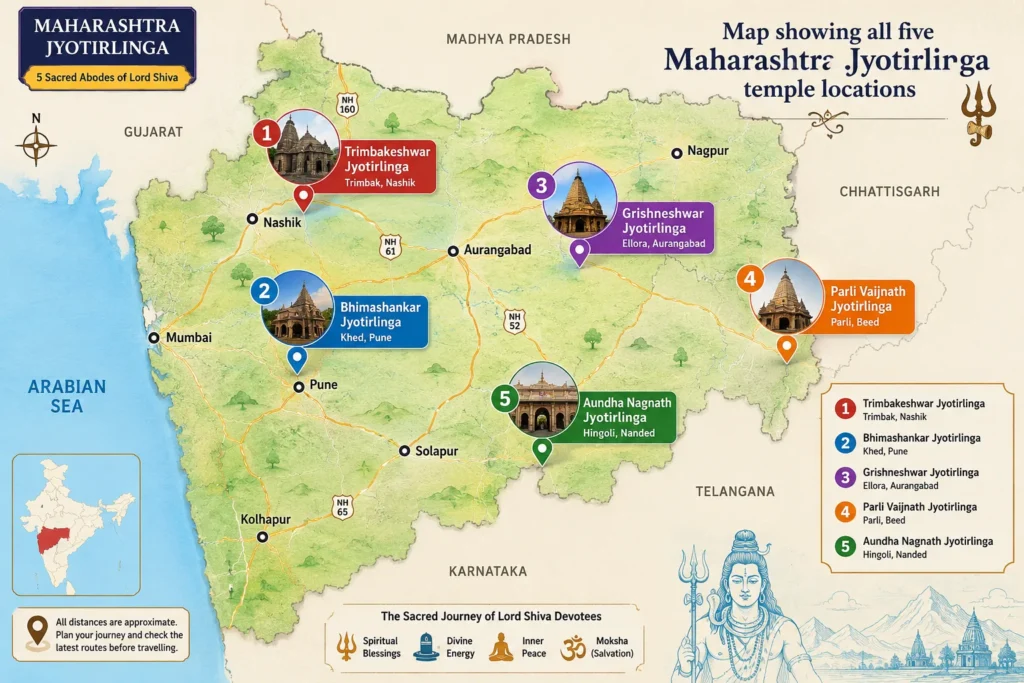
If you searched for Maharashtra Jyotirlinga, here is your answer straight away: Maharashtra is home to more Jyotirlingas than any other Indian state. Three are universally accepted — Bhimashankar (near Pune), Trimbakeshwar (near Nashik), and Grishneshwar (near Ellora, Chhatrapati Sambhajinagar). Two more — Aundha Nagnath (Hingoli) and Parli Vaijnath (Beed) — are revered by crores of devotees as the Nageshwar and Vaidyanath Jyotirlingas of the sacred twelve. That means a single, well-planned trip through one state can bring you darshan of up to five of Lord Shiva’s most powerful shrines.
I have driven these routes, stood in these queues at 4:30 in the morning, eaten at the bhojanalayas outside the temple gates, and made most of the mistakes I warn you about below. This guide compresses all of that into one page: history, legends, temple-by-temple details, routes from Mumbai, Pune and Nashik, itineraries for 3, 5 and 7 days, realistic budgets, and answers to more than 40 questions pilgrims actually ask.
Whether you are a family with children, a senior citizen planning a comfortable darshan yatra, a solo traveller, or an international visitor curious about Hindu pilgrimage, everything you need is here. Bookmark it — you will come back to it while packing. And if you would rather have everything arranged for you, our curated Maharashtra Jyotirlinga tour packages handle the routes, stays and darshan planning end to end.
Table of Contents
- What is Maharashtra Jyotirlinga?
- Why Maharashtra is Special for Shiva Devotees
- History of Jyotirlingas
- Mythological Significance
- Shiva Purana References
- Complete List of Maharashtra Jyotirlingas (Temple-by-Temple Guide)
– Bhimashankar
– Trimbakeshwar
– Grishneshwar
– Aundha Nagnath
– Parli Vaijnath - Maharashtra Jyotirlinga Map
- Suggested Routes (Mumbai, Pune, Nashik)
- 3-Day Itinerary
- 5-Day Itinerary
- 7-Day Itinerary
- Budget Planning
- Suggested Tour Packages
- Family Travel Tips
- Senior Citizen Tips
- Women Traveller Tips
- Safety Tips
- Best Months to Visit & Weather Guide
- Festivals, Mahashivratri & Shravan Guides
- Things to Carry & Checklists
- Local Foods
- Nearby Attractions
- Comparison Tables
- Practical Essentials: Parking, ATMs, Networks, Medical, Emergency Numbers
- Temple Etiquette, Dos & Don’ts, Local Customs, Marathi Phrases
- 40+ Frequently Asked Questions
- Conclusion, Key Takeaways & Next Steps
1. What is Maharashtra Jyotirlinga?
A Jyotirlinga literally means “linga of light” (jyoti = light, linga = the symbolic form of Shiva). Hindu tradition holds that at twelve places on earth, Lord Shiva manifested himself as an infinite column of light. These twelve shrines — the Dwadash Jyotirlingas — are considered the most sacred Shiva temples in existence, different from ordinary Shiva temples because the deity here is believed to be swayambhu (self-manifested), not installed by human hands.
When people say “Maharashtra Jyotirlinga,” they usually mean the group of Jyotirlinga temples located within Maharashtra state:
- Bhimashankar — Pune district, deep in the Sahyadri mountains
- Trimbakeshwar — Nashik district, at the origin of the holy River Godavari
- Grishneshwar — near Ellora Caves, Chhatrapati Sambhajinagar (Aurangabad) district
- Aundha Nagnath — Hingoli district, identified by many traditions as the Nageshwar Jyotirlinga
- Parli Vaijnath — Beed district, identified by many traditions as the Vaidyanath Jyotirlinga
The last two are subjects of a friendly, centuries-old debate. Gujarat’s Nageshwar (near Dwarka) and Jharkhand’s Baidyanath (Deoghar) also claim the same names. Rather than treating this as a problem, most seasoned pilgrims treat it as a blessing: visiting all five Maharashtra shrines covers every possibility, and the devotion at Aundha and Parli is as intense as anywhere in India.
Quick answer for voice search: How many Jyotirlingas are in Maharashtra? Three undisputed (Bhimashankar, Trimbakeshwar, Grishneshwar) and five if you count Aundha Nagnath and Parli Vaijnath — the highest number of any Indian state.
2. Why Maharashtra is Special for Shiva Devotees
No other state lets you complete such a large portion of the Dwadash Jyotirlinga yatra in one journey. But the significance runs deeper than convenience:
The land itself is Shaiva. Maharashtra’s spiritual geography is saturated with Shiva. The Godavari — southern India’s Ganga — rises at Trimbakeshwar from the Brahmagiri hill. The Bhima river rises at Bhimashankar. Rivers born at Jyotirlingas water half the Deccan.
A living devotional tradition. The Warkari saints of Maharashtra — Dnyaneshwar, Namdev, Eknath, Tukaram — wove Shiva devotion into everyday Marathi life. Namdev’s transformative meeting with his guru Visoba Khechara happened inside the Aundha Nagnath temple, a story every Marathi child knows.
Architecture across a thousand years. In one trip you see Hemadpanthi stone construction (Aundha Nagnath, roughly 13th century), Maratha-Peshwa temple architecture (Trimbakeshwar, 18th century), the red-stone artistry of Ahilyabai Holkar’s restorations (Grishneshwar), and — a short walk from Grishneshwar — the rock-cut Kailasa temple of Ellora, arguably the greatest Shiva monument ever carved.
Every kind of pilgrim is served. Bhimashankar offers forest and trekking; Trimbakeshwar offers Vedic ritual (it is India’s foremost centre for Narayan Nagbali and Kaal Sarp Dosh pujas); Grishneshwar pairs darshan with world heritage; Aundha and Parli offer the quiet, uncrowded devotion that big shrines have lost.
3. History of Jyotirlingas
The Jyotirlinga tradition is ancient in belief and layered in history. The twelve-shrine list appears in the Shiva Purana (Koti Rudra Samhita) and is echoed in the famous Dwadasha Jyotirlinga Stotram attributed to Adi Shankaracharya (8th century CE), which pilgrims still recite daily:
“Saurashtre Somanatham cha Srisaile Mallikarjunam, Ujjayinyam Mahakalam, Omkaram Amaleshwaram…”
The stotram names Bhimashankar (“Dakinyam Bhimashankaram”), Trimbakeshwar (“Setubandhe tu Ramesham, Nagesham Darukavane… Trayambakam Gautamitate”), and Grishneshwar (“Shivalaye Ghushmesham”), anchoring all three Maharashtra shrines in the earliest canonical list.
Historically, the temples you see today are younger than the shrines they house. Repeated invasions of the Deccan between the 13th and 17th centuries damaged many original structures. What followed was one of India’s great acts of devotional rebuilding: Nana Saheb Peshwa (Balaji Bajirao) reconstructed Trimbakeshwar in black basalt in the 18th century; the queen Ahilyabai Holkar of Indore — the greatest temple-builder of her age — rebuilt or renovated Grishneshwar and Parli Vaijnath in the same era; and Maratha nobility, including the Chimaji Appa bell at Bhimashankar (a Portuguese church bell taken at the Battle of Vasai in 1739), left their mark across all five sites. So a Maharashtra Jyotirlinga yatra is also a journey through Maratha history.
4. Mythological Significance
The root story of every Jyotirlinga is the same magnificent scene. Brahma and Vishnu once argued over who was supreme. Shiva appeared between them as an endless pillar of blazing light and challenged each to find its end. Vishnu, as a boar, dug downward for aeons and returned admitting failure. Brahma, flying upward as a swan, lied that he had found the top, producing a ketaki flower as false witness. Shiva punished the lie — Brahma would have no temples of worship — and rewarded Vishnu’s honesty. The places where fragments of that infinite light touched the earth became the Jyotirlingas.
Each Maharashtra shrine then carries its own legend:
- Bhimashankar — Shiva destroyed the demon Tripurasura here; the sweat of the battle became the Bhima river. Another tradition links the site to Bhima, son of the demon Kumbhakarna.
- Trimbakeshwar — Sage Gautama, tricked into the sin of cow-slaughter, performed penance here; Shiva released the Ganga as the Godavari to purify him and stayed as Trimbaka, “the three-eyed lord.”
- Grishneshwar — The devoted Ghushma kept her faith even when her jealous sister killed her son; Shiva restored the boy to life and remained here at her request as Ghushmeshwar.
- Aundha Nagnath — Believed to be the first (Adya) Jyotirlinga by local tradition; the Pandavas, led by Yudhishthira, are said to have built the original temple during their exile.
- Parli Vaijnath — Linked to the Samudra Manthan: Dhanvantari and the amrit (nectar of immortality) were hidden inside the Shivling here, which is why touching this linga is believed to confer health — Vaijnath/Vaidyanath means “Lord of Physicians.”
5. Shiva Purana References
For devotees who want scriptural grounding, the Koti Rudra Samhita of the Shiva Purana is the primary source. It narrates the origin of each of the twelve Jyotirlingas in sequence, and its verses promise that one who recites the names of the twelve shrines morning and evening is cleansed of the sins of seven lifetimes.
Relevant chapters describe: the slaying of Tripurasura and Shiva’s residence at Bhimashankar; Gautama Rishi’s penance, Ganga’s descent as Godavari, and Shiva’s manifestation as Tryambakeshwar; and the story of Ghushma’s unshakeable devotion at Shivalaya (Verul/Ellora), where the temple tank is still called Shivalaya Tirtha. The Nageshwar chapter (the demon Daruka and the devotee Supriya) and the Vaidyanath chapter (Ravana offering his heads to Shiva and carrying the linga south) are claimed by Aundha Nagnath and Parli Vaijnath respectively in Maharashtra’s regional tradition.
You do not need Sanskrit scholarship to feel this. Local priests at each temple happily narrate these stories — ask for the sthala purana (the shrine’s own legend), and if you can, listen to it sitting in the sabha mandap rather than reading it on your phone. It lands differently.
6. Complete List of All Maharashtra Jyotirlingas — Temple-by-Temple Guide
(Timings and fees below are the generally followed schedules; temple trusts adjust them during Shravan, Mahashivratri, and eclipses. Always reconfirm on the official trust website or by phone a day before you travel.)
6.1 Bhimashankar Jyotirlinga (Pune District)
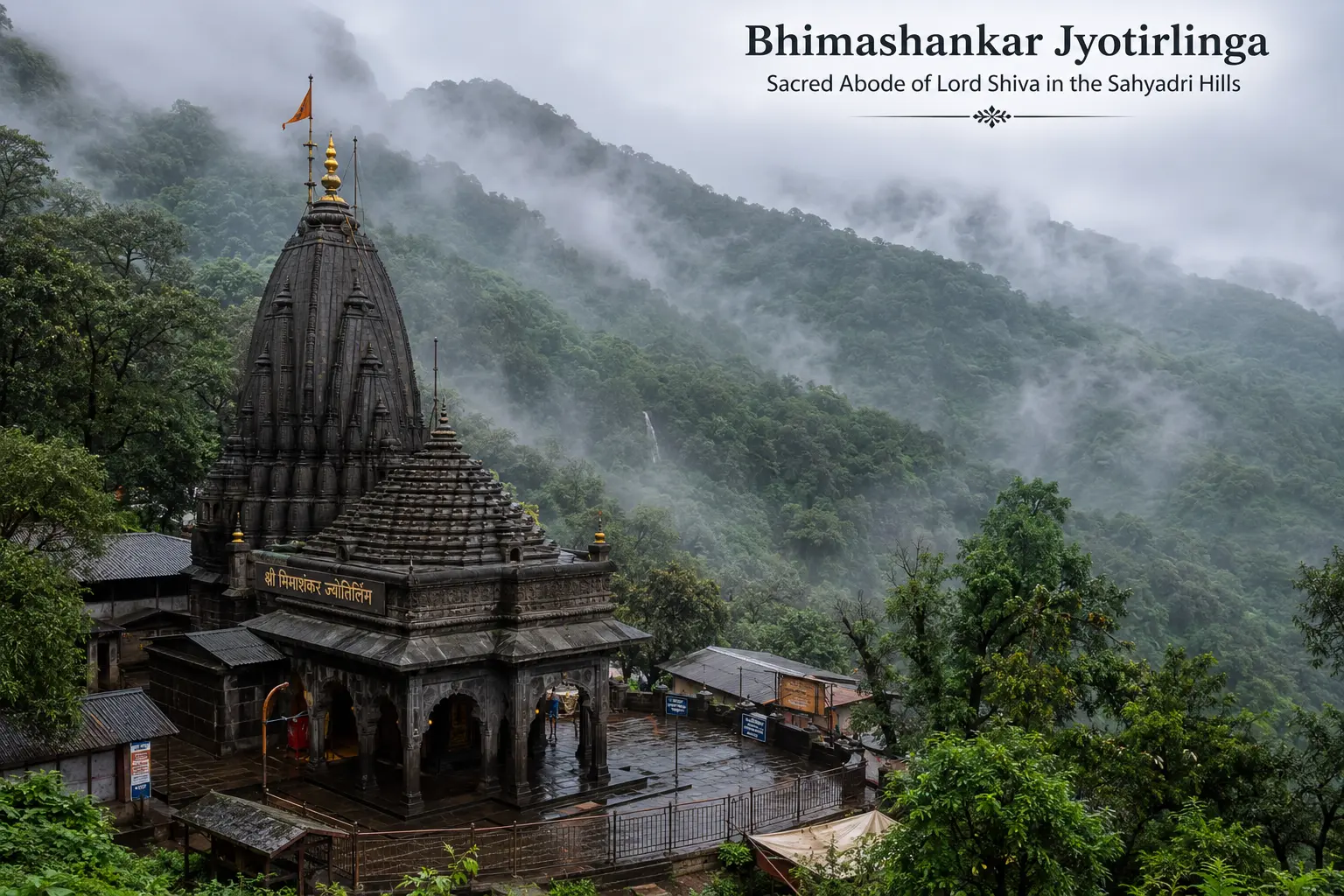
History
Bhimashankar sits at about 3,250 ft in the Sahyadri range, roughly 110 km from Pune. The sabha mandap is an 18th-century addition by the statesman Nana Phadnavis, while the shikhara and core shrine are older Nagara-style work. The famous large bell in the courtyard was gifted by Chimaji Appa after the Battle of Vasai (1739). The surrounding forest was declared the Bhimashankar Wildlife Sanctuary in 1984 and is the home of the Shekru — the Indian giant squirrel, Maharashtra’s state animal.
Legend
Shiva took the form of Bhima-Shankara to destroy the demon Tripurasura, who had terrorised the three worlds. After the battle, the sweat that poured from Shiva’s body became the River Bhima, which rises just behind the temple.
Architecture
Classic Nagara style with a curvilinear shikhara, intricately carved wooden sabha mandap, and a garbhagriha set lower than the courtyard — you step down to the linga, which stays partly bathed in water year-round.
Importance
The 6th Jyotirlinga in the traditional order. Unique because it is simultaneously a tirtha, a river source, and a biodiversity hotspot.
Practical details
| Detail | Information |
|---|---|
| Temple timings | ~4:30 AM – 9:30 PM daily |
| Aarti timings | Kakada aarti ~4:30 AM; Madhyan (noon) aarti ~12:00 PM; Shej aarti ~9:00 PM |
| Entry fee | Free. Paid options: abhishek/puja tickets from the temple counter; special darshan line may operate on peak days |
| Dress code | Modest Indian wear preferred; avoid shorts/sleeveless. Traditional dress (dhoti/sovala) needed only if you book an abhishek inside the sanctum |
| Photography | Prohibited inside the sanctum; allowed in the courtyard and surroundings |
| Nearest railway station | Pune Junction (~110 km) |
| Nearest airport | Pune Airport (~125 km) |
| Road connectivity | Good tar road via Manchar–Ghodegaon; last 30 km is winding ghat. MSRTC buses run from Pune (Shivajinagar) |
| Best time to visit | October–February for clear weather; monsoon (June–September) for waterfalls and mist, but expect slippery steps and leeches on forest trails |
| Where to stay | Basic lodges and bhakta niwas near the temple; better hotels/resorts at Manchar (55 km) or stay in Pune and do a day trip |
| Food | Simple Maharashtrian thali joints and tea stalls near the gate; try garam poha and kanda bhaji in the mist |
| Local transport | Everything near the temple is walkable; share jeeps run from parking to the steps on crowded days |
| Suggested duration | Half a day (plus 3–4 hours if you add a sanctuary walk) |
| Important rituals | Rudrabhishek, laghurudra; morning jal abhishek by devotees is allowed in non-peak hours |
| Festivals | Mahashivratri (biggest), Shravan Mondays, Kartik Poornima |
| Photography spots | The mist-covered approach road, Gupt Bhimashankar (forest walk to the hidden river origin), Nagphani/Cobra’s Hood viewpoint |
| Elderly accessibility | Around 200+ steps from parking to temple; palkhi (palanquin) carriers and dolis available for hire near the car park. Start early to avoid queue fatigue |
Travel tips & common mistakes
- Mistake #1: Arriving at noon on a Monday. Queues balloon. Reach by 6 AM.
- Mistake #2: Trusting mobile maps for shortcuts. Stick to the Manchar route; “shorter” village roads are rough.
- Carry a light jacket even in summer — the plateau is always cooler than Pune.
- Fuel up at Manchar; there is no petrol pump near the temple.
6.2 Trimbakeshwar Jyotirlinga (Nashik District)
History
The present temple was built between 1755 and 1786 by Nana Saheb Peshwa (Balaji Bajirao) entirely in black basalt — one of the finest surviving examples of Maratha temple architecture. The town of Trimbak, 28 km from Nashik, sits at the foot of Brahmagiri hill, from which the Godavari river rises. The sacred Kusavarta Kund, built by Shrimant Raosaheb Parnerkar, is where the Godavari first collects and is one of the starting points of the Nashik Kumbh Mela.
Legend
Sage Gautama, framed for the sin of killing a cow, prayed to Shiva to bring the Ganga south to wash away his sin. Ganga descended as the Godavari, and Shiva remained here at Gautama’s request as Trimbaka.
Architecture
Massive black-stone Nagara-style structure within a fortified enclosure. The most unusual feature is inside: the linga is not a raised column but a small depression containing three thumb-sized lingas representing Brahma, Vishnu and Mahesh (Shiva) — unique among all twelve Jyotirlingas. A jewelled crown (said to date from the Pandava era) is displayed on Mondays from ~4–5 PM.
Importance
The only Jyotirlinga embodying the Trimurti; the source of the Godavari; India’s principal centre for Narayan Nagbali, Kaal Sarp Dosh, and Tripindi Shraddha rituals, which by tradition can be performed only here.
Practical details
| Detail | Information |
|---|---|
| Temple timings | ~5:30 AM – 9:00 PM daily |
| Aarti timings | Morning puja/aarti ~5:30–6:00 AM; Madhyan puja ~1:00 PM; Shej aarti after ~7:00 PM (crown darshan Monday afternoons) |
| Entry fee | Free general darshan. Paid special darshan ticket (typically ₹200) with a shorter line |
| Dress code | Strict for sanctum entry: men in dhoti/sovala only (and only during limited hours, roughly 6–7 AM for abhishek); women in saree/salwar. General darshan: modest clothing |
| Photography | Prohibited inside the temple complex; mobile deposit counters available |
| Nearest railway station | Nashik Road (~36 km) |
| Nearest airport | Nashik (Ozar) Airport (~50 km); Mumbai airport (~200 km) has far more flights |
| Road connectivity | Excellent — 28 km from Nashik on a good state highway; buses, share taxis and autos every few minutes |
| Best time to visit | October–March; the town is pleasant year-round due to hill climate |
| Where to stay | Dozens of lodges, dharamshalas and mid-range hotels in Trimbak town; full range of hotels in Nashik city |
| Food | Pure-veg Marathi thali houses everywhere; Nashik is famous for misal pav — eat it |
| Local transport | Trimbak town is walkable; autos for Kushavarta/nearby temples |
| Suggested duration | Half a day for darshan; full day if performing a puja; add half a day for Brahmagiri trek |
| Important rituals | Narayan Nagbali (3-day ritual), Kaal Sarp Dosh puja, Rudrabhishek, Tripindi Shraddha — book only through the authorised purohit sangh (licensed priests carry ID) |
| Festivals | Mahashivratri, Shravan (every Monday sees lakhs), Nivrittinath Yatra, Kumbh Mela (every 12 years; next Nashik Kumbh cycle is 2026–27 — expect enormous crowds) |
| Photography spots | Kusavarta Kund at dawn, temple facade from the main street, Brahmagiri summit views |
| Elderly accessibility | Temple is at street level — one of the easiest Jyotirlingas for seniors. Wheelchairs can reach the queue complex; special darshan ticket strongly recommended to cut standing time |
Travel tips & common mistakes
- Mistake #1: Booking Kaal Sarp puja with touts at the bus stand. Use only priests authorised by the temple trust; agree the full price in writing before starting.
- Mistake #2: Planning Trimbakeshwar on a Shravan Monday “for the atmosphere.” The atmosphere is 4–6 hour queues. Go Tuesday–Thursday instead.
- Keep footwear at the official stand (token system) — informal “free” stands may demand money later.
- If the Kumbh window is active during your 2026–27 visit, book rooms months ahead.
6.3 Grishneshwar Jyotirlinga (Chhatrapati Sambhajinagar District)
History
Grishneshwar (also spelt Ghrishneshwar/Ghushmeshwar) stands in Verul village, barely 1 km from the Ellora Caves, about 30 km from Chhatrapati Sambhajinagar (Aurangabad). The temple was rebuilt in the 16th century by Maloji Bhosale (grandfather of Chhatrapati Shivaji Maharaj) and given its present red-stone form in the 18th century by Ahilyabai Holkar. It is traditionally counted as the 12th and final Jyotirlinga — many pilgrims deliberately end their all-India yatra here.
Legend
Ghushma, a devout woman, made and worshipped 101 Shiva lingas daily, immersing them in the local tank. Her jealous sister murdered Ghushma’s son, yet Ghushma continued her worship unshaken. Shiva restored the boy to life and, moved by her devotion, stayed forever as Ghushmeshwar — “Lord of Ghushma.”
Architecture
Compact but exquisite: red volcanic rock, a five-tiered shikhara, and dashavatara carvings on the walls. The 24-pillared sabha mandap and the Nandi facing the sanctum are favourite study subjects for architecture students — the Holkar-era craftsmanship rewards slow looking.
Importance
The concluding Jyotirlinga of the twelve; the only one adjacent to a UNESCO World Heritage Site (Ellora); one of the few where devotees may touch the linga and perform abhishek with their own hands during permitted hours.
Practical details
| Detail | Information |
|---|---|
| Temple timings | ~5:30 AM – 9:30 PM (extended to ~11 PM–3 AM cycles during Shravan/Mahashivratri) |
| Aarti timings | Mangal aarti ~5:30 AM; Madhyan aarti ~12 noon; evening aarti ~7:30–8:00 PM |
| Entry fee | Free; small fee for abhishek materials if you perform jal abhishek |
| Dress code | The strictest of the five: men must remove shirts, vests and belts to enter the garbhagriha. Women in saree/salwar; modest dress mandatory |
| Photography | Strictly prohibited inside; mobiles must be deposited at lockers before entry |
| Nearest railway station | Chhatrapati Sambhajinagar (Aurangabad) station (~30 km) |
| Nearest airport | Chhatrapati Sambhajinagar Airport (~35 km) — direct flights from Mumbai and Delhi |
| Road connectivity | Excellent 30-km road from the city via Daulatabad and Khuldabad; buses and taxis constant |
| Best time to visit | October–March (pairs perfectly with Ellora sightseeing weather) |
| Where to stay | Limited basic lodges in Verul; best to stay in Chhatrapati Sambhajinagar city (all budgets, from ₹800 lodges to 5-star) |
| Food | Local thali and snack stalls in Verul; the city offers famous Naan Qalia (non-veg) and superb veg thalis — keep non-veg for after darshan days if you observe custom |
| Local transport | Autos/taxis between city, Daulatabad Fort, Ellora and the temple; MSRTC buses frequent |
| Suggested duration | 2–3 hours for temple; full day combined with Ellora |
| Important rituals | Self-performed jal abhishek (queue for it in the morning), Rudrabhishek by temple priests |
| Festivals | Mahashivratri fair, Shravan Mondays, Ganesh–Gauri local processions |
| Photography spots | The shikhara from the temple tank side at golden hour; Ellora’s Kailasa temple; Daulatabad fort ramparts en route |
| Elderly accessibility | Street-level entry with a short queue corridor — easy for seniors outside festival days. Shirt-removal rule applies to elderly men too; wear an easily removable kurta |
Travel tips & common mistakes
- Mistake #1: Visiting Ellora first. Do the temple at 6 AM, then Ellora at 9 AM opening — you beat both queues and the heat. (Note: Ellora is closed on Tuesdays.)
- Mistake #2: Carrying your phone to the sanctum. You will be sent back to the locker line, losing your queue position.
- Combine Daulatabad Fort + Khuldabad + Ellora + Grishneshwar in one perfect day loop.
6.4 Aundha Nagnath (Nageshwar) Jyotirlinga (Hingoli District)
History
Aundha Nagnath, in Marathwada’s Hingoli district, is by local tradition the Adya (first) Jyotirlinga. The original temple is attributed to Yudhishthira, eldest of the Pandavas, during their forest exile. The present structure is a masterpiece of 13th-century Hemadpanthi architecture (Yadava era) — built of interlocked black stone without mortar. The upper shikhara was rebuilt later (an Ahilyabai Holkar-era restoration) after damage during medieval invasions, which is why the base and the tower visibly differ in style.
Legend
Two legends live here. First, the Shiva Purana’s Nageshwar story of the demon Daruka and the imprisoned devotee Supriya, whose prayers brought Shiva bursting forth to protect him. Second, the beloved Marathi story of Sant Namdev: rebuked for singing bhajans at the temple’s front, Namdev moved to the rear — and the temple itself is said to have turned so its entrance faced him. To this day, the Nandi sits at the back of the temple, unlike any other major Shiva shrine.
Architecture
The finest carving on this entire yatra. The plinth is wrapped in bands of elephants, dancers, deities and floral scrolls; the garbhagriha is underground, reached by narrow steps — you descend into cool stone darkness to reach the linga. Corbelled Hemadpanthi ceilings inside are remarkable.
Practical details
| Detail | Information |
|---|---|
| Temple timings | ~4:00/4:30 AM – 9:00 PM |
| Aarti timings | Morning aarti ~4:30–5:00 AM; Madhyan aarti ~12 noon; Shej aarti ~8:30 PM |
| Entry fee | Free |
| Dress code | Modest traditional wear; men may be asked to remove shirts for sanctum abhishek |
| Photography | Allowed of the exterior carvings (a highlight!); prohibited in the underground sanctum |
| Nearest railway station | Chondi/Aundha Nagnath halt is minor; practical railheads are Hingoli (~25 km) and Parbhani Junction (~50 km) on the Secunderabad line |
| Nearest airport | Chhatrapati Sambhajinagar (~210 km) or Nanded (~100 km, limited flights) |
| Road connectivity | State highways from Parbhani, Hingoli and Nanded; roads are decent but narrow — daylight driving recommended |
| Best time to visit | October–February; Marathwada summers (April–June) cross 42°C |
| Where to stay | Very basic lodges and bhakta niwas at Aundha; better hotels in Parbhani, Hingoli or Nanded |
| Food | Simple, honest Marathwada thalis — jowar bhakri, pithla, thecha. Limited restaurants; eat at meal hours |
| Local transport | Autos in town; MSRTC buses connect Parbhani/Hingoli hourly |
| Suggested duration | 2–3 hours |
| Important rituals | Underground abhishek, Rudrabhishek; Mahashivratri fair is the great event |
| Festivals | Mahashivratri yatra (huge rural fair), Shravan Mondays, Vijayadashami |
| Photography spots | The carved plinth in slanting morning light — bring your best lens |
| Elderly accessibility | The main challenge on this yatra: the sanctum is down steep, narrow, low-ceilinged steps. Seniors with knee or heart conditions should take darshan from the mandap above — priests will perform abhishek on their behalf |
Travel tips & common mistakes
- Mistake: Underestimating travel time. Aundha is genuinely rural; keep buffers, carry cash, download offline maps.
- The descent to the sanctum is single-file; on festival days, elderly and claustrophobic visitors should choose non-peak hours.
6.5 Parli Vaijnath (Vaidyanath) Jyotirlinga (Beed District)
History
Parli Vaijnath in Beed district is Maharashtra’s claimant to the Vaidyanath Jyotirlinga. The temple, on a small hillock ringed by stone walls, was renovated in 1706 and later by Ahilyabai Holkar. Parli sits at a symbolic confluence — the region is associated with both Shiva (Vaijnath) and, at nearby Ambajogai, the goddess Yogeshwari, making it a twin pilgrimage for many Marathwada families.
Legend
During the churning of the ocean (Samudra Manthan), fourteen treasures emerged, including Dhanvantari (the divine physician) and the amrit. To protect the nectar from demons, it was hidden within the Shivling here. Hence “Vaijnath” — Lord as the ultimate Healer — and hence the belief that darshan and touch of this linga restores health. A parallel tradition connects the site to Ravana’s carrying of the Atmalinga, the story shared with Deoghar.
Architecture
Fort-like enclosure, broad stone steps (ghats) leading up, a spacious courtyard with deepmalas (lamp towers), and a sanctum where — unusually — the linga may be touched by all devotees regardless of caste or gender, a point of pride locals will happily tell you about. The linga is of shaligram stone.
Practical details
| Detail | Information |
|---|---|
| Temple timings | ~5:00 AM – 9:00 PM (extended in Shravan) |
| Aarti timings | Morning aarti ~5:15 AM; Madhyan aarti ~12 noon; Shej aarti ~8:00 PM |
| Entry fee | Free; paid abhishek tickets available |
| Dress code | Modest wear; traditional dress for abhishek in the sanctum |
| Photography | Courtyard yes; sanctum no |
| Nearest railway station | Parli Vaijnath station (2–3 km) — the only Maharashtra Jyotirlinga with its own railhead, connected to Parbhani, Latur, and long-distance trains |
| Nearest airport | Chhatrapati Sambhajinagar (~220 km); Latur airport (~60 km, very limited services) |
| Road connectivity | Good roads from Latur (55 km), Ambajogai (25 km), Beed (90 km), Nanded (~120 km) |
| Best time to visit | October–February |
| Where to stay | Decent budget lodges and trust-run bhakta niwas in Parli town; better options in Latur or Ambajogai |
| Food | Marathwada veg thalis; Parli’s morning market has excellent local produce and snacks |
| Local transport | Autos everywhere; station-to-temple auto ~10 minutes |
| Suggested duration | 2–3 hours |
| Important rituals | Personal sparsh-darshan (touching the linga), Rudrabhishek, health-related sankalp pujas |
| Festivals | Mahashivratri (major fair), Shravan, Vijayadashami and Tripuri Poornima with special processions |
| Photography spots | The stepped approach and deepmalas at dusk |
| Elderly accessibility | A flight of broad steps to climb, but railings exist and the pace is unhurried; manageable for most seniors with rest stops |
Travel tips & common mistakes
- Mistake: Skipping Parli because it’s “far.” It has the best rail connectivity of all five — overnight trains make it easy.
- Pair with Ambajogai’s Yogeshwari Devi temple (25 km) — locals consider the yatra incomplete without it.
7. Maharashtra Jyotirlinga Map (Where Each Temple Sits)
Picture Maharashtra as a rough triangle. The five shrines split neatly into a western pair and an eastern (Marathwada) trio:
- Trimbakeshwar — top-left of the state, 28 km west of Nashik, in the hills where the Godavari begins.
- Bhimashankar — western Sahyadris, 110 km north-west of Pune, 220 km from Mumbai. No railhead nearby; road only.
- Grishneshwar — centre of the state, 30 km from Chhatrapati Sambhajinagar, beside Ellora. The natural hinge between the western and eastern halves of the yatra.
- Parli Vaijnath — deep south-east, Beed district, ~220 km from Grishneshwar via Beed/Ambajogai.
- Aundha Nagnath — east, Hingoli district, ~85–90 km north of Parli via Vasmat.
Key distances (road, approximate): Mumbai→Bhimashankar 220 km · Pune→Bhimashankar 110 km · Bhimashankar→Trimbakeshwar 210 km · Nashik→Trimbakeshwar 28 km · Trimbakeshwar→Grishneshwar 190 km · Grishneshwar→Parli Vaijnath 220 km · Parli→Aundha Nagnath 90 km · Aundha→Chhatrapati Sambhajinagar 210 km · Aundha→Nanded 100 km.
The total circuit — Mumbai → Bhimashankar → Trimbakeshwar → Grishneshwar → Parli → Aundha → back — runs roughly 1,100–1,250 km.
8. Suggested Routes
From Mumbai
- By road: Mumbai → Pune expressway → Manchar → Bhimashankar (Day 1) → back via Junnar/Sangamner → Nashik/Trimbakeshwar (Day 2) → Sambhajinagar/Grishneshwar (Day 3) → Beed → Parli (Day 4) → Aundha (Day 5) → return via Jalna–Sambhajinagar or by overnight train.
- By train: Mumbai→Nashik Road (Panchavati Exp, ~4 hrs) for Trimbakeshwar; Mumbai→Chh. Sambhajinagar (Devagiri/Janshatabdi, 6–7 hrs) for Grishneshwar; Mumbai→Parli Vaijnath (direct overnight trains) for Parli and onward Aundha by road. Bhimashankar is road-only from Pune.
- By flight: Mumbai→Chh. Sambhajinagar (45 min) puts you at the centre of the circuit; hire a car from there.
From Pune
Pune is the best base for Bhimashankar (110 km, 3–3.5 hrs). Classic loop: Pune → Bhimashankar → Narayangaon → Sangamner → Nashik (Trimbakeshwar) → Shirdi (optional) → Sambhajinagar (Grishneshwar) → Parli → Aundha → return to Pune via Jalna–Ahmednagar (long day) or train from Parbhani/Parli.
From Nashik
Start with Trimbakeshwar at your doorstep → Sambhajinagar (Grishneshwar, ~180 km via Yeola–Vaijapur) → Parli → Aundha → return, adding Bhimashankar on the way back via Sangamner–Manchar. Nashik start suits North Indian pilgrims arriving by train.
Route comparison
| Route | Total distance | Days needed | Best for |
|---|---|---|---|
| Mumbai full circuit (road) | ~1,400 km | 5–6 | Families with own car |
| Pune full circuit (road) | ~1,200 km | 5 | Most balanced option |
| Nashik start (road+rail mix) | ~1,100 km | 4–5 | Pilgrims arriving from North India |
| Rail-based (Nashik+Sambhajinagar+Parli) | Flexible | 5–6 | Budget & senior travellers |
| Fly-drive via Sambhajinagar | ~700 km driving | 3–4 | Time-poor & international visitors |
9. 3-Day Itinerary (The Three Undisputed Jyotirlingas)
Day 1 — Pune → Bhimashankar → Nashik. Leave Pune 5 AM, darshan by 9 AM, breakfast at the plateau stalls, drive to Nashik by evening (via Sangamner). Night in Nashik; eat misal pav.
Day 2 — Trimbakeshwar → Sambhajinagar. Darshan at 6 AM, Kusavarta Kund, optional quick Brahmagiri viewpoint, lunch in Nashik, afternoon drive (~180 km) to Chhatrapati Sambhajinagar. Night halt.
Day 3 — Grishneshwar + Ellora → return. Temple at 6 AM, Ellora Caves 9 AM–1 PM, Daulatabad fort drive-by, evening flight/train/drive home.
Total driving: ~600 km. Works for weekenders taking one day’s leave.
10. 5-Day Itinerary (All Five Shrines)
Day 1: Pune/Mumbai → Bhimashankar darshan → night at Nashik.
Day 2: Trimbakeshwar morning → drive to Sambhajinagar → evening Daulatabad/Bibi-ka-Maqbara.
Day 3: Grishneshwar dawn darshan → Ellora till noon → drive to Parli (~220 km) → night Parli.
Day 4: Parli Vaijnath morning darshan → Ambajogai Yogeshwari → drive to Aundha (90 km) → evening darshan → night Aundha/Parbhani.
Day 5: Aundha morning aarti → return: drive to Sambhajinagar for flight, or Parbhani/Parli for train home.
11. 7-Day Itinerary (Relaxed, Senior-Friendly)
Adds breathing room and bonus tirthas:
Day 1: Mumbai/Pune → Bhimashankar (afternoon sanctuary walk) → night Manchar.
Day 2: Drive to Nashik via Ozar/Lenyadri Ganpati (optional Ashtavinayak add-on) → evening Panchavati ghat aarti in Nashik.
Day 3: Trimbakeshwar full day — darshan, Kusavarta, any planned puja.
Day 4: Nashik → Shirdi (Sai Baba darshan, optional) → Sambhajinagar night.
Day 5: Grishneshwar + Ellora + Khuldabad + Daulatabad.
Day 6: Drive to Parli via Beed → Parli Vaijnath evening aarti → night Parli.
Day 7: Parli sparsh-darshan at dawn → Ambajogai → Aundha Nagnath → night train from Parbhani or halt at Nanded (add Hazur Sahib Gurudwara if time permits).
12. Budget Planning (Per Person, 5-Day All-Five Trip)
| Head | Budget | Mid-range | Luxury |
|---|---|---|---|
| Transport | MSRTC/sleeper trains: ₹1,500–2,500 | Shared Innova/AC train: ₹4,000–6,000 | Private SUV with driver: ₹12,000–18,000 |
| Stay (4 nights) | Dharamshala/lodge ₹400–800/night: ₹2,000–3,000 | 3-star ₹1,800–3,000/night: ₹8,000–12,000 | 4–5 star where available: ₹20,000+ |
| Food | Thalis & stalls: ₹1,500 | Restaurants: ₹3,000 | Hotel dining: ₹6,000+ |
| Pujas/darshan tickets | ₹200–500 | ₹1,000–2,500 | ₹5,000+ (special abhisheks) |
| Misc./buffer | ₹500 | ₹1,500 | ₹3,000 |
| Total (approx.) | ₹6,000–8,000 | ₹18,000–25,000 | ₹45,000–55,000+ |
Money-saving truths: trust-run bhakta niwas rooms are clean and cheapest; MSRTC’s Shivshahi AC buses cover most legs; travelling Tuesday–Thursday cuts both crowds and hotel rates. Before finalising a DIY budget, compare it against our ready-made Jyotirlinga tour packages — for families, packages sometimes work out cheaper than self-planning.
13. Suggested Tour Packages
If you want a pre-planned, hassle-free yatra, start with Travel Shrine’s own Maharashtra Jyotirlinga tour packages — built around the exact routes and timings recommended in this guide. Beyond that, here are the other reliable options:
- MTDC & MSRTC pilgrim circuits: Maharashtra tourism and the state bus corporation periodically run Jyotirlinga darshan packages from Mumbai/Pune — the cheapest organised option; check their official sites for current departures.
- IRCTC Bharat Gaurav / pilgrim specials: IRCTC operates Jyotirlinga-themed tourist trains covering Maharashtra shrines with onboard meals — excellent for seniors travelling without family.
- Private operators (Pune/Nashik based): 4–6 day tempo-traveller group tours, typically ₹9,000–15,000 per head including stay and veg meals. Verify the operator includes all five temples — many cover only three.
- Custom cab packages: A 5-day private sedan/SUV with driver runs ₹11–14/km plus driver allowance (~₹300–400/night). For a family of four, this often beats per-head group tours on comfort per rupee.
14. Family Travel Tips
- Anchor each day around one temple morning + one light attraction afternoon; children fade fast in queues.
- Book rooms with early check-in — darshan days start at 5 AM and everyone needs an afternoon nap.
- Turn legends into bedtime stories the night before each temple; kids engage completely differently when they know Ghushma’s story before seeing Grishneshwar.
- Carry a small daypack per child: water, biscuits, cap, one toy. Queues test patience.
- Keep one “zero-temple” buffer half-day in any trip over four days.
15. Senior Citizen Tips
- Easiest to hardest for mobility: Trimbakeshwar (street-level) → Grishneshwar (street-level) → Parli (broad steps with railings) → Bhimashankar (200+ steps; doli/palkhi available) → Aundha Nagnath (steep underground sanctum — take darshan from the mandap instead).
- Buy special/paid darshan tickets wherever offered; the ₹200 saves hours of standing.
- Carry a folding stool for queues, all medicines in original strips with prescriptions, and a card listing blood group and emergency contacts.
- Travel October–February only; avoid Shravan Mondays and Mahashivratri entirely.
- Prefer the IRCTC train packages or a private car; avoid night driving on Marathwada roads.
16. Women Traveller Tips
Solo women travel this circuit routinely — temple towns are among Maharashtra’s safest spaces, filled with families and grandmothers who will adopt you within minutes.
– Dress modestly (salwar/kurta ideal); it also keeps sanctum entry friction-free.
– Choose lodges on main streets near the temple, not isolated highway properties.
– For Marathwada legs (Parli/Aundha), prefer day travel and trains over late-night buses.
– Save the women’s helpline 1091 and share live location with family.
– During heavy-crowd events, use the separate women’s darshan queues where provided.
17. Safety Tips (Everyone)
- Beware self-appointed “guides” and puja touts at Trimbakeshwar and Bhimashankar; deal only with authorised priests and official counters.
- Ghat driving (Bhimashankar road): honk on blind curves, never overtake on the ghat, avoid post-sunset descent in monsoon fog.
- Keep footwear tokens, phone-deposit tokens, and cash in a zipped pouch — pickpocketing exists in dense queues.
- Drink packaged/boiled water in rural stretches.
- Emergency: 112 (all-in-one), 108 (ambulance), 100 (police), 1091 (women), 1363 (tourist helpline).
18. Best Months to Visit & Weather Guide
| Season | Months | What it’s like | Verdict |
|---|---|---|---|
| Winter | Nov–Feb | 10–28°C, dry, clear | Best overall — ideal everywhere |
| Post-monsoon | Oct | Green hills, waterfalls fading, mild | Excellent, slightly humid |
| Summer | Mar–Jun | Marathwada 38–44°C; Bhimashankar plateau milder | Avoid Parli/Aundha afternoons; dawn darshans only |
| Monsoon | Jun–Sep | Bhimashankar/Trimbak drenched, misty, magical; landslip & leech risk on treks | Beautiful for the western temples if you accept rain; slow driving |
Weather precautions: summer — electrolytes, caps, dawn schedules; winter — one warm layer for 4:30 AM aartis (plateau mornings touch 8–10°C); monsoon — quick-dry clothes, footwear with grip, waterproof phone pouch.
Rainy season / monsoon travel guide: The Bhimashankar ghat and Trimbak hills receive very heavy rain (July peaks). Roads stay open but expect 20–30% longer drive times, occasional debris, and cancelled forest-trail access. Grishneshwar, Parli and Aundha receive far less rain and remain fully comfortable. If your dates are fixed in monsoon, reverse the circuit: do Marathwada first, hills last, watching forecasts.
19. Festivals at the Maharashtra Jyotirlingas
- Mahashivratri (Feb/Mar): the supreme festival at all five — all-night temples, fairs, lakhs of devotees.
- Shravan (Jul/Aug): every Monday is a mini-Mahashivratri; kanwariyas carry Godavari water to the shrines.
- Kartik Poornima & Tripuri Poornima (Nov): deepotsav at Bhimashankar (Tripurasura victory) and Parli.
- Nashik Kumbh Mela (every 12 years; 2026–27 cycle): Trimbakeshwar becomes one of the holiest places on earth — and one of the most crowded.
- Local yatras: Aundha’s rural Mahashivratri fair and Parli–Ambajogai joint processions are wonderful windows into Marathwada folk devotion.
20. Mahashivratri Guide
Expect 4–8 hour queues at Trimbakeshwar and Bhimashankar; 2–4 at the others. Temples run near-continuous darshan through the night with four prahar pujas. Strategy: reach the previous evening, sleep early, join the line by 3 AM, or deliberately come the day after — the decorations remain, the crowd doesn’t. Seniors and families with small children should genuinely consider the day-after option. Carry nothing but water, tokens and devotion; cloakrooms overflow on this one night.
21. Shravan Month Guide
Shravan (the holiest Shiva month, July–August in Maharashtra’s calendar) transforms the circuit: temples open earlier and close later, special laghurudra and rudrabhishek bookings fill weeks ahead, and Mondays (Shravani Somvar) see the year’s biggest regular crowds. If you want the festive energy without the crush, visit Shravan Tuesday–Thursday: decorations, chants and extended hours, at one-tenth the queue. Book pujas directly through temple trust offices in advance, and expect vegetarian-only dining everywhere near the shrines throughout the month.
22. Things to Carry — Travel & Packing Checklist
Documents & money: ID cards (mandatory for special darshan/pujas), ₹3,000–5,000 cash for rural stretches, UPI as primary.
Clothing: 2 sets modest traditional wear, one dhoti/sovala for men planning abhisheks, easily-removable kurta for Grishneshwar, warm layer, quick-dry towel.
Footwear: slip-on sandals (you remove footwear 10+ times a day) + one grip shoe for Bhimashankar/Brahmagiri.
Health: personal medicines, ORS, band-aids, pain-relief spray, sunscreen, mosquito repellent.
Temple kit: small steel lota for jal abhishek, bel patra/flowers bought at each gate, a cloth bag (plastic is banned at several temples).
Tech & misc.: power bank, offline maps downloaded, torch (Aundha’s sanctum steps), folding stool for seniors, reusable water bottle.
Dos: bathe before darshan · keep phones in lockers without arguing · follow queue marshals · donate at official hundis only · keep silence in the garbhagriha.
Don’ts: no leather items in sanctums · no photography past marked lines · don’t touch the linga except where explicitly allowed (Grishneshwar/Parli) · don’t buy “guaranteed VIP darshan” from strangers · no alcohol/non-veg on darshan days.
23. Local Foods to Try
- Nashik/Trimbak: misal pav (fiery sprout curry), sabudana khichdi (fasting staple), fresh grapes and raisins in season.
- Pune belt/Bhimashankar: kanda bhaji in the mist, thalipeeth, mastani drinks back in Pune.
- Sambhajinagar: legendary veg thalis; Naan Qalia for non-veg days after the pilgrimage.
- Marathwada (Parli/Aundha): jowar bhakri with pithla and thecha, shengdana chutney, hurda (roasted tender jowar) in winter.
- Everywhere: temple prasad — Bhimashankar’s and Parli’s laddus travel well.
24. Nearby Attractions Worth Adding
- Ellora Caves & Kailasa temple (1 km from Grishneshwar) — non-negotiable; closed Tuesdays.
- Daulatabad Fort & Khuldabad (en route to Grishneshwar).
- Bibi-ka-Maqbara, Sambhajinagar city.
- Panchavati, Ramkund & Muktidham, Nashik; Sula/vineyard visits for a leisure evening.
- Brahmagiri hill trek and Anjaneri (Hanuman’s birthplace) near Trimbak.
- Bhimashankar Wildlife Sanctuary trails; Gupt Bhimashankar.
- Shirdi (90 km from Nashik) and Ashtavinayak Ganpatis (Ozar/Lenyadri) as add-ons.
- Ambajogai Yogeshwari temple (25 km from Parli); Nanded’s Hazur Sahib (100 km from Aundha).
Instagram-worthy / photo spots: misty Bhimashankar approach road · Kusavarta Kund reflections at dawn · Grishneshwar’s red shikhara at golden hour · Aundha’s carved plinth in side-light · Parli’s deepmalas at dusk · Kailasa temple from the upper rim.
Sunrise picks: Kusavarta Kund (Trimbak), Parli temple steps.
Sunset picks: Nagphani point (Bhimashankar), Daulatabad ramparts, Ellora upper viewpoint.
Suggested photo captions: “Where light touched the earth — Maharashtra’s Jyotirlinga trail” · “Five shrines, one state, one Shiva” · “Mist, mountains and Mahadev at Bhimashankar” · “The Godavari begins where prayers do — Trimbakeshwar” · “Ending the twelve where pilgrims end them — Grishneshwar.”
25. Comparison Tables
Temple comparison
| Temple | District | Deity legend | Architecture | Crowd level | Elderly ease | Unique feature |
|---|---|---|---|---|---|---|
| Bhimashankar | Pune | Tripurasura vadh | Nagara, 18th-c. mandap | High (weekends) | Moderate (steps/doli) | Inside a wildlife sanctuary |
| Trimbakeshwar | Nashik | Gautama & Godavari | Peshwa black basalt | Very high | Easiest | Three-linga Trimurti; Kumbh site |
| Grishneshwar | Chh. Sambhajinagar | Ghushma’s devotion | Holkar red stone | High | Easy | 12th Jyotirlinga; beside Ellora |
| Aundha Nagnath | Hingoli | Daruka/Supriya; Namdev | Hemadpanthi, 13th c. | Low | Difficult (underground) | Finest carvings; rear-facing Nandi |
| Parli Vaijnath | Beed | Amrit & Dhanvantari | Fort-style hillock | Low–moderate | Moderate (steps) | Everyone may touch the linga; own railway station |
Distance chart (km, approx.)
| From \ To | Bhimashankar | Trimbakeshwar | Grishneshwar | Parli | Aundha |
|---|---|---|---|---|---|
| Mumbai | 220 | 180 | 335 | 480 | 550 |
| Pune | 110 | 235 | 235 | 370 | 440 |
| Nashik | 200 | 28 | 180 | 370 | 400 |
| Grishneshwar | 260 | 180 | — | 220 | 230 |
| Parli | 370 | 370 | 220 | — | 90 |
Travel cost comparison (5-day, per person)
| Mode | Approx. cost | Comfort | Flexibility |
|---|---|---|---|
| MSRTC buses + dharamshalas | ₹6,000–8,000 | Basic | Medium |
| Train + local taxis + budget hotels | ₹10,000–14,000 | Good | Medium |
| Group tempo-traveller package | ₹9,000–15,000 | Good | Low |
| Private car + 3-star hotels | ₹18,000–25,000 | Very good | High |
| Fly-drive + 4-star | ₹40,000+ | Excellent | High |
Travel duration comparison
| Leg | By road | By train | Notes |
|---|---|---|---|
| Mumbai→Nashik | 3.5–4 hrs | ~4 hrs (Panchavati Exp) | Train wins on comfort |
| Pune→Bhimashankar | 3–3.5 hrs | No rail | Road only |
| Nashik→Sambhajinagar | 4–4.5 hrs | 3.5–4.5 hrs | Either works |
| Sambhajinagar→Parli | 5–5.5 hrs | ~5 hrs (via Parbhani) | Overnight trains from Mumbai exist |
| Parli→Aundha | 2–2.5 hrs | Road best | Rural highway |
Facilities comparison
| Facility | Bhimashankar | Trimbakeshwar | Grishneshwar | Aundha | Parli |
|---|---|---|---|---|---|
| Paid/special darshan | Peak days | Yes (₹200) | Peak days | No | Abhishek tickets |
| Cloakroom/lockers | Yes | Yes | Yes (mandatory for phones) | Basic | Yes |
| Wheelchair-friendly | Partial | Yes | Yes | No (sanctum) | Partial |
| Doli/palkhi service | Yes | Not needed | Not needed | No | No |
| Bhakta niwas (trust stay) | Yes | Yes | Limited | Basic | Yes |
| Restaurants nearby | Basic | Many | Moderate | Few | Moderate |
| ATM within 2 km | 1–2 (unreliable) | Several | In Verul/city | 1–2 | Several |
| Hospital nearby | PHC; Manchar 55 km | Nashik 28 km | City 30 km | Hingoli 25 km | Civil hospital in town |
26. Practical Essentials
Parking: Bhimashankar — large paid lot ~500 m below the steps (₹50–100; fills by 8 AM on weekends). Trimbakeshwar — municipal lots at town entry; walk 10 minutes. Grishneshwar — paid lot near the temple lane shared with Ellora traffic. Aundha & Parli — free/cheap open lots beside the temples.
Mobile network: Jio and Airtel work at all five towns; expect dead zones on the Bhimashankar ghat and patchy 4G between Beed–Parli–Aundha. Download offline maps and keep printed hotel addresses for Marathwada.
ATM availability: Reliable in Nashik, Trimbak, Sambhajinagar, Parli, Latur. Unreliable at Bhimashankar and Aundha — carry cash for these two.
Medical facilities: District hospitals at Nashik, Sambhajinagar, Hingoli, Beed; primary health centres near each temple; pharmacies in every temple town (most close by 10 PM). Seniors: note that Bhimashankar’s nearest full hospital is ~55 km away at Manchar — carry adequate medication.
Emergency numbers: 112 (national emergency) · 100 (police) · 108 (ambulance) · 101 (fire) · 1091 (women’s helpline) · 1363 / 1800-22-9930 (tourist helpline) · 138 (railway passenger helpline).
27. Temple Etiquette, Local Customs & Useful Marathi
Temple etiquette: Enter right foot first; circumambulate clockwise (pradakshina); never point feet at the deity; offer bel patra with the smooth side touching the linga; accept prasad in the right hand; keep phones silent even where allowed; queues part respectfully for palkhi processions — step aside.
Local customs: Mondays are Shiva’s day — expect crowds and plan accordingly. Many families observe vegetarian food throughout the yatra. At Grishneshwar, the men’s shirt-removal rule is non-negotiable and applies to everyone including foreigners — it is a mark of humility, not inconvenience. In Marathwada, elders are greeted with a slight bow and “Namaskar”; the warmth you receive back will be one of the trip’s memories.
Children guide: Keep darshan slots short and mornings-only; assign each child a “story of the temple” to retell at dinner; use child ID wristbands in big crowds; the Ellora day is the children’s favourite — schedule it mid-trip as a reward.
Useful Marathi phrases:
– Namaskar — Hello/greetings
– Dhanyavad / Aabhari aahe — Thank you
– Mandir kuthe aahe? — Where is the temple?
– Kiti vajta ughadta? — What time does it open?
– Kiti paise? — How much money?
– Pani milel ka? — Can I get water?
– Madat kara — Please help
– Darshan-la kiti vel lagel? — How long will darshan take?
– Chha-an! — Wonderful!
28. Frequently Asked Questions
Q1. How many Jyotirlingas are there in Maharashtra?
Maharashtra has three universally accepted Jyotirlingas — Bhimashankar, Trimbakeshwar and Grishneshwar — and two more shrines, Aundha Nagnath and Parli Vaijnath, which large traditions identify as the Nageshwar and Vaidyanath Jyotirlingas of the twelve. Counting all claimants, Maharashtra hosts five, the most of any Indian state. Most serious pilgrims visit all five in one circuit so that no interpretation of the sacred list is left uncovered, which typically takes five comfortable days by road.
Q2. Which are the 3 main Jyotirlingas in Maharashtra?
The three undisputed shrines are Bhimashankar in the Sahyadri hills of Pune district, Trimbakeshwar near Nashik at the source of the Godavari river, and Grishneshwar beside the Ellora Caves in Chhatrapati Sambhajinagar district. All three appear by name in Adi Shankaracharya’s Dwadasha Jyotirlinga Stotram and in the Shiva Purana’s Koti Rudra Samhita, which is why no tradition disputes them. They can be covered together in a well-planned three-day road trip from Mumbai or Pune.
Q3. Can I visit all Maharashtra Jyotirlingas in 3 days?
You can comfortably cover the three undisputed shrines in three days — Bhimashankar on day one, Trimbakeshwar on day two, and Grishneshwar with Ellora on day three, driving roughly 600 km in total. Covering all five in three days is technically possible but punishing: it means about 1,100 km, pre-dawn starts daily, and no margin for queues. For all five, give yourself five days; your knees, your family and your darshan experience will thank you.
Q4. What is the best time to visit Maharashtra Jyotirlinga temples?
October to February is ideal: daytime temperatures of 22–30°C, cool mornings for aarti, and dry roads everywhere including the Marathwada stretches. Monsoon (June–September) turns Bhimashankar and Trimbakeshwar spectacularly green and misty, but ghat driving slows and forest trails may close. Summer (March–June) is harsh in Parli and Aundha, where afternoons cross 42°C; if summer is unavoidable, complete darshans before 10 AM and rest through the afternoons.
Q5. Which Jyotirlinga should I visit first?
Tradition does not mandate a sequence for the Maharashtra shrines, so start with whichever is nearest your entry point: Bhimashankar if coming from Pune, Trimbakeshwar from Nashik or North India, Grishneshwar if flying into Chhatrapati Sambhajinagar. Many pilgrims deliberately keep Grishneshwar last because it is traditionally the twelfth and final Jyotirlinga, making it a symbolic completion point. Local tradition at Aundha Nagnath, meanwhile, honours it as the first — beginning there is equally meaningful.
Q6. Is there a dress code at these temples?
Yes, and it varies. Everywhere, modest clothing is expected — no shorts, sleeveless tops or short skirts. Grishneshwar is strictest: men must remove shirts, vests and belts before entering the sanctum. Trimbakeshwar requires men to wear a dhoti/sovala for inner-sanctum abhishek, permitted only in limited morning hours, while women wear sarees or salwar suits for rituals. For ordinary darshan at all five temples, clean traditional or simply modest attire is sufficient.
Q7. Are mobile phones allowed inside the temples?
Phones and cameras are prohibited inside all five sanctums. Grishneshwar enforces this most strictly, with mandatory locker deposit before the queue; Trimbakeshwar has deposit counters at the entrance. At Bhimashankar, Aundha and Parli you may carry a phone in the outer complex but must keep it away near the garbhagriha. Use the official cloakrooms and lockers, keep the token safe, and never hand devices to informal “minders” outside the gates.
Q8. What are the temple timings at Bhimashankar?
Bhimashankar generally opens around 4:30 AM with the Kakada aarti and closes about 9:30 PM. The noon Madhyan aarti briefly pauses darshan, and afternoon hours often feature Shringar darshan when the linga is decorated. During Shravan and Mahashivratri, hours extend and queues begin well before dawn. Since hill weather and festival schedules cause adjustments, reconfirm timings with the temple trust a day before travelling, especially if you plan an early abhishek.
Q9. What are the Trimbakeshwar temple timings?
Trimbakeshwar is typically open from 5:30 AM to 9:00 PM. Devotee-performed abhishek inside the sanctum is limited to a narrow early-morning window (roughly 6–7 AM, men in sovala), while the special crown darshan is displayed on Monday afternoons around 4–5 PM. Major pujas such as Kaal Sarp and Narayan Nagbali run on their own morning schedules booked with authorised priests. Timings flex during Shravan, Kumbh periods and eclipses, so verify before you go.
Q10. How do I reach Bhimashankar from Mumbai?
Drive via the Mumbai–Pune Expressway to Chakan, then through Rajgurunagar and Manchar to the temple — about 220 km and five and a half to six hours including the final winding ghat. Alternatively, take a train or bus to Pune and continue by MSRTC bus from Shivajinagar (about 4 hours) or hired cab. There is no railhead near the temple. Start before dawn: you clear city traffic, catch the misty ghat at its most beautiful, and reach before the queues build.
Q11. How do I reach Trimbakeshwar from Mumbai?
Take the Kasara ghat route by road — roughly 180 km, four to four and a half hours — or the comfortable Panchavati/other expresses to Nashik Road station (about four hours), then a taxi or bus for the final 36 km to Trimbak. Buses to Trimbak leave Nashik’s CBS stand every few minutes. Flying is unnecessary from Mumbai. If you arrive by an early morning train, you can complete darshan the same forenoon and still have the evening for Nashik’s Panchavati ghats.
Q12. How do I reach Grishneshwar?
Fly or take a train to Chhatrapati Sambhajinagar (Aurangabad), then cover the final 30 km to Verul village by taxi, auto-package or MSRTC bus — about 45 minutes via Daulatabad. Direct flights connect Mumbai and Delhi; overnight trains connect Mumbai (Devagiri Express) and other cities. By road, the temple is around 335 km from Mumbai and 235 km from Pune. Because Ellora is one kilometre away, nearly every visitor pairs the two in a single unforgettable day.
Q13. How do I reach Parli Vaijnath and Aundha Nagnath?
Parli is the easiest by rail: Parli Vaijnath station sits 2–3 km from the temple, with direct trains from Mumbai, Pune and Secunderabad-line junctions like Parbhani and Latur. Aundha Nagnath is road-connected — about 90 minutes from Parli via Vasmat, 25 km from Hingoli, and 50 km from Parbhani Junction. Most pilgrims do the pair together in one day: Parli’s sparsh-darshan at dawn, Ambajogai midway, and Aundha’s carved marvel by afternoon.
Q14. Is there an entry fee at Maharashtra Jyotirlinga temples?
General darshan is free at all five temples. Optional paid services exist: Trimbakeshwar sells a special-darshan ticket (typically ₹200) with a shorter queue, and every temple offers priced abhisheks and pujas through official counters — from about ₹100 for basic jal abhishek materials to several thousand rupees for laghurudra performed by priests. Pay only at official counters against receipts; anyone selling “instant VIP darshan” on the street is running a scam.
Q15. What is special about the Trimbakeshwar linga?
Uniquely among the twelve Jyotirlingas, Trimbakeshwar’s sanctum holds not one raised linga but a small hollow containing three thumb-sized lingas venerated as Brahma, Vishnu and Mahesh together — the full Trimurti in one shrine. Water from the Godavari’s source constantly seeps around them. On Monday afternoons the temple displays a jewelled golden crown over the deity, traditionally dated to the Pandava era. This Trimurti form is why the lord here is called Trimbaka, the three-eyed.
Q16. Can devotees touch the Shivling at these temples?
It depends on the temple. At Grishneshwar, devotees may enter the sanctum and perform jal abhishek with their own hands during permitted hours, men bare-chested. At Parli Vaijnath, everyone — regardless of gender or background — may touch the linga, a distinctive local pride. Trimbakeshwar restricts sanctum entry to a brief morning window in traditional dress; at Bhimashankar and Aundha, access rules vary by crowd and hour. Always follow the priests’ live instructions rather than assumptions.
Q17. What is Kaal Sarp Dosh puja at Trimbakeshwar?
Kaal Sarp Dosh is an astrological condition where all planets sit between Rahu and Ketu in a birth chart, traditionally believed to cause obstacles. Trimbakeshwar is India’s foremost sanctioned venue for its remedial puja, along with Narayan Nagbali and Tripindi Shraddha rites. The puja takes a morning; Narayan Nagbali takes three days. Book only through the authorised purohit sangh — licensed priests carry identity cards — agree fees in advance, and ignore the touts who swarm the bus stand promising cheaper ceremonies.
Q18. Why do men remove shirts at Grishneshwar?
The rule embodies humility and ritual purity: entering Shiva’s innermost presence without stitched upper garments is an old Deccan tradition preserved strictly at Grishneshwar. Belts and leather items are removed for the same reason — leather is ritually impure inside sanctums. The rule applies to every male, including elderly visitors and international guests, and is enforced politely but firmly. Wear an easily removable kurta, hand it to a family member or locker, and treat the custom as part of the darshan itself.
Q19. Is Bhimashankar trek difficult?
The temple itself needs no trek — vehicles reach the parking area, and about 200-plus steps descend to the shrine. The famous treks are separate: the Ganesh Ghat and Shidi Ghat trails climb from Khandas village at the base, taking three to five hours, with Shidi Ghat’s ladders being genuinely challenging in rain. Inside the sanctuary, gentle walks lead to Gupt Bhimashankar and Nagphani viewpoint. Pilgrims wanting only darshan should drive up; trekkers should attempt trails in post-monsoon months.
Q20. Are these temples open all year?
Yes, all five Jyotirlingas remain open every single day of the year, including monsoon. Daily schedules pause briefly for noon aarti and cleaning, and hours extend — sometimes to near round-the-clock — during Mahashivratri and Shravan. The only practical disruptions are weather-related: heavy monsoon days can slow the Bhimashankar ghat road, and Kumbh-period crowd controls at Trimbakeshwar can reroute entry lines. There is no seasonal closure anywhere on this circuit, unlike Himalayan shrines.
Q21. Which Maharashtra Jyotirlinga is best for senior citizens?
Trimbakeshwar and Grishneshwar are the gentlest: both sit at street level with short, managed queues outside festival days, and Trimbakeshwar’s paid special-darshan ticket cuts standing time dramatically. Parli involves a broad but railed stairway most seniors manage with rest stops. Bhimashankar’s 200-plus steps are offset by doli and palkhi services for hire. Aundha Nagnath’s steep underground sanctum is the one genuine difficulty — seniors should take darshan from the mandap above while priests perform abhishek on their behalf.
Q22. Is the Maharashtra Jyotirlinga circuit safe for solo women travellers?
Yes — this is among India’s most family-dense pilgrimage circuits, and solo women complete it routinely. Sensible practices apply: modest dress, main-street lodges near temples rather than isolated highway hotels, daytime travel on the rural Parli–Aundha stretch, and pre-booked cabs over late-night buses. Temple towns wake at 4 AM and sleep by 10 PM, so align your rhythm with theirs. Save helpline 1091, share live location with family, and use women’s queues where provided.
Q23. What should I carry for the yatra?
Essentials: government ID (needed for pujas and special darshan), ₹3,000–5,000 cash for rural stretches, slip-on footwear, modest traditional clothing plus a removable kurta for Grishneshwar, personal medicines with prescriptions, ORS sachets, a small steel lota for abhishek, cloth bag for offerings, power bank, torch for Aundha’s dark stairway, and a warm layer for pre-dawn aartis. Seniors should add a folding stool for queues. Download offline maps — network gaps exist on ghats and in Marathwada.
Q24. Can I do jal abhishek myself at these temples?
Yes, at specific temples and hours. Grishneshwar allows devotees to pour water on the linga personally during designated morning windows. Parli Vaijnath permits touch and offering for all devotees. Bhimashankar allows devotee abhishek in non-peak hours at the priests’ discretion. Trimbakeshwar restricts it to the early-morning sovala window for men. Carry your own small lota, buy water/milk at the temple gate, and follow the queue marshals — on crowded days, self-abhishek may be paused entirely.
Q25. What is the story of Bhimashankar Jyotirlinga?
The Shiva Purana narrates that the demon Tripurasura, drunk on a boon, tormented the three worlds until the gods begged Shiva for rescue. Shiva assumed a colossal form — Bhima-Shankara — and destroyed the demon on these Sahyadri heights. The sweat that streamed from his body during battle became the River Bhima, which still rises behind the temple. At the gods’ request, Shiva remained here as a Jyotirlinga, radiating the fierce protective energy devotees come to absorb.
Q26. What is the story of Grishneshwar Jyotirlinga?
Ghushma, a Shiva devotee, daily crafted and worshipped 101 clay lingas, immersing them in the village tank. Her envious elder sister Sushma killed Ghushma’s young son and threw him into that very tank. Ghushma, steadfast, completed her worship regardless — and saw her son walk out of the water alive. Shiva, overwhelmed by such unshakeable faith, forgave even the murderess at Ghushma’s request and stayed eternally as Ghushmeshwar, the Lord of Ghushma.
Q27. Why is Aundha Nagnath’s Nandi behind the temple?
Locals tell the beloved story of Sant Namdev, who was singing bhajans at the temple entrance when authorities objected and sent him to the rear. As Namdev resumed his kirtan behind the shrine, the temple itself is said to have rotated so that its face — and its Lord — turned toward the devotee. Ever since, the Nandi sits at the back, a permanent stone testimony that God turns toward sincere devotion, ignoring rank and protocol. Visitors still circle to the rear to honour the spot.
Q28. Why is Parli Vaijnath called the healer’s shrine?
The name Vaijnath (Vaidyanath) means “Lord of Physicians.” Legend holds that during the ocean-churning, the divine physician Dhanvantari and the nectar of immortality were concealed within this Shivling to protect them from demons. Touching the linga is therefore believed to transmit health and vitality, which is why sparsh-darshan — physical touch — is open to every devotee here. Families across Marathwada bring ailing relatives for darshan, and health-related sankalp pujas are the temple’s most requested ritual.
Q29. What is the significance of Kusavarta Kund?
Kusavarta Kund in Trimbak town is the ceremonial source of the Godavari, where the river — having disappeared underground after emerging on Brahmagiri hill — reappears and collects in a stone tank. A dip here is held equal in merit to bathing in the Ganga, and the kund serves as a principal bathing site of the Nashik Kumbh Mela. Pilgrims collect its water to carry to the Jyotirlinga for abhishek. Dawn, when chants echo over the still water, is the most beautiful hour to visit.
Q30. When is Mahashivratri, and how crowded does it get?
Mahashivratri falls on the fourteenth night of the dark fortnight of Phalguna (February–March), the night Shiva is honoured with four prahar pujas till dawn. At Trimbakeshwar and Bhimashankar expect four to eight hours in queue; Grishneshwar, Parli and Aundha run two to four hours amid huge rural fairs. Temples stay open essentially all night. Strategies that work: join the line by 3 AM, use paid darshan where offered, or visit the following day when decorations remain and crowds vanish.
Q31. What happens during Shravan month at these temples?
Shravan (July–August) is Shiva’s holiest month. All five temples extend hours, hold special rudrabhishek and laghurudra recitations, and dress the deities elaborately. Every Monday — Shravani Somvar — draws the year’s largest regular crowds, with kanwariyas carrying Godavari water to the shrines on foot. Eateries around the temples turn fully vegetarian. For festive atmosphere without crushing queues, visit Tuesday to Thursday during Shravan: you get the decorations, chanting and energy at a fraction of the waiting time.
Q32. Is photography allowed at Maharashtra Jyotirlinga temples?
Exterior and courtyard photography is generally welcome — Aundha Nagnath’s carved plinth and Grishneshwar’s red shikhara are photographers’ favourites — but every sanctum bans cameras and phones absolutely. Grishneshwar requires phone deposit in lockers before queueing; Trimbakeshwar prohibits photography through most of the complex. Drones are banned at all religious sites without police permission. When in doubt, ask a temple volunteer; a polite question in Marathi or Hindi is always answered kindly, and rule-breaking risks confiscation.
Q33. Which airport is best for the Jyotirlinga circuit?
Chhatrapati Sambhajinagar (Aurangabad) airport is the strategic centre — Grishneshwar is 35 km away, and both arms of the circuit radiate from the city. Mumbai and Pune airports offer far more flight options and suit travellers starting with Bhimashankar or Trimbakeshwar. Nashik’s Ozar airport has limited services. A proven fly-drive plan for time-poor visitors: fly into Sambhajinagar, complete Grishneshwar–Parli–Aundha by car, then finish with Trimbakeshwar and depart from Mumbai after Bhimashankar.
Q34. Are there good hotels near these temples?
Comfort varies sharply. Nashik and Chhatrapati Sambhajinagar offer everything from ₹800 lodges to five-star properties, making them the circuit’s best overnight bases. Trimbak town has dozens of decent pilgrim hotels and dharamshalas. Bhimashankar has only basic lodges — most visitors stay in Pune or Manchar. Parli and Aundha offer clean budget lodges and trust-run bhakta niwas; travellers wanting better rooms sleep at Latur, Parbhani or Nanded. Book ahead for weekends, Shravan and Mahashivratri everywhere.
Q35. What food is available near the temples? Is it vegetarian?
Food near all five temples is overwhelmingly pure vegetarian Maharashtrian: thalis with jowar or wheat bhakri, pithla, varan-bhaat, and fasting foods like sabudana khichdi. Nashik adds its famous misal pav; Marathwada serves memorable thecha and shengdana chutney. Non-vegetarian food and alcohol are unavailable in immediate temple zones and considered inappropriate during darshan days; city hotels in Nashik and Sambhajinagar serve everything. Carry fruit and biscuits for early-morning queue hours before eateries open.
Q36. Can international tourists visit these temples?
Absolutely — all five welcome foreign visitors warmly, and no permits are required. Follow the same rules as everyone: modest dress, shoes off, phones deposited, and the bare-chest rule for men at Grishneshwar’s sanctum. Hindi and basic English work at major temples; in Marathwada, a few Marathi phrases and translation apps help. Pairing the yatra with Ellora and Ajanta makes Maharashtra a world-class heritage-plus-spirituality itinerary. Carry passport copies for hotel check-ins and puja registrations.
Q37. What is the difference between Nageshwar in Gujarat and Aundha Nagnath?
Both claim the “Nagesham Darukavane” verse of the Jyotirlinga stotram. Gujarat’s Nageshwar near Dwarka identifies Darukavana with its coastal forest; Maharashtra’s tradition places it at Aundha, citing the temple’s antiquity, the Pandava-era attribution and centuries of regional worship. A third claimant exists at Jageshwar in Uttarakhand. Scripture does not settle the geography, so pilgrims commonly visit more than one. Practically, Aundha rewards every visitor regardless of the debate — its Hemadpanthi carving alone justifies the journey.
Q38. Is Parli Vaijnath the same as Deoghar Baidyanath?
They are rival claimants to the single Vaidyanath Jyotirlinga of the twelve. Jharkhand’s Baidyanath Dham at Deoghar anchors the Ravana-and-Atmalinga legend in the east; Parli anchors the Dhanvantari-and-amrit tradition in the Deccan, with Ahilyabai Holkar’s patronage and Marathwada’s unbroken devotion behind it. The Dwadasha stotram’s phrase “Paralyam Vaidyanatham” is read by Maharashtra tradition as naming Parli directly. Devotees who visit both consider the question beautifully resolved: Shiva is not short of addresses.
Q39. How much does the full yatra cost per person?
A five-day, all-five-temples circuit costs roughly ₹6,000–8,000 travelling by state buses and dharamshalas, ₹18,000–25,000 with a private car and three-star hotels, and ₹45,000-plus for fly-drive luxury. Major variables are transport mode, puja bookings (a Kaal Sarp puja adds ₹2,000–5,000-plus), and season — Shravan and Mahashivratri inflate room rates. Families of four sharing a private car often spend less per head than individuals on group packages, with far more comfort and flexibility.
Q40. Do I need to book darshan online in advance?
As of now, none of the five temples requires general online darshan booking — you simply arrive and queue. Trimbakeshwar’s special ₹200 darshan and various abhisheks can be arranged at counters on the day; ritual pujas like Narayan Nagbali should be booked days ahead directly with authorised priests. During Kumbh windows and Mahashivratri, temporary online or token systems are sometimes introduced — check each temple trust’s official website in the week before travel, and ignore third-party “booking” websites charging fees.
Q41. Which nearby attractions should I not miss?
Ellora’s rock-cut Kailasa temple, one kilometre from Grishneshwar, is unmissable — many travellers rank it above the Taj Mahal for sheer audacity (closed Tuesdays). Add Daulatabad Fort en route, Panchavati and Kusavarta in the Nashik–Trimbak belt, the Bhimashankar sanctuary walk to Gupt Bhimashankar, and Ambajogai’s Yogeshwari temple near Parli. With extra days, Shirdi, the Ozar and Lenyadri Ashtavinayak temples, and Nanded’s Hazur Sahib Gurudwara slot naturally into the same routes.
Q42. Is the circuit doable by public transport only?
Yes, thousands do it monthly. The skeleton: train to Nashik Road → bus to Trimbakeshwar → bus/train to Chhatrapati Sambhajinagar → bus to Grishneshwar → train via Parbhani to Parli Vaijnath → bus to Aundha via Hingoli → and for Bhimashankar, MSRTC buses from Pune’s Shivajinagar stand. Budget six days rather than five, travel mornings, and keep evenings for rest. MSRTC’s Shivshahi AC buses and the dense Marathwada rail network make this India’s most public-transport-friendly Jyotirlinga cluster.
29. Conclusion
The Maharashtra Jyotirlinga circuit is the rare pilgrimage that gives you everything at once: the mist and forests of Bhimashankar, the river-birth sanctity of Trimbakeshwar, the world-heritage grandeur beside Grishneshwar, and the quiet, carved intensity of Aundha Nagnath and Parli Vaijnath. In five days and one state, you walk through the Shiva Purana, Maratha history, Hemadpanthi artistry, and living Marathi devotion — and you come home with the satisfaction of having covered nearly half the sacred twelve.
Plan for winter, start your days before dawn, book pujas only through official channels, and leave room in your schedule for the unplanned — the chai stall conversation, the aarti you didn’t intend to stay for, the Namdev story told by a priest at the back of Aundha’s temple. Those are the moments this guide cannot schedule for you, and they are the ones you will remember.
Key Takeaways
- Maharashtra has 3 undisputed Jyotirlingas (Bhimashankar, Trimbakeshwar, Grishneshwar) and 5 counting Aundha Nagnath and Parli Vaijnath — the most of any state.
- 5 days / ~1,200 km is the sweet spot for the full circuit; 3 days covers the undisputed three.
- October–February is the best season; avoid Shravan Mondays and Mahashivratri unless crowds are the point.
- Trimbakeshwar and Grishneshwar are easiest for seniors; Aundha’s underground sanctum is the hardest.
- Budget ₹6,000–8,000 (basic) to ₹25,000 (comfortable) per person for five days.
- Dress codes are real: sovala at Trimbakeshwar’s sanctum, bare chest for men at Grishneshwar.
- Book ritual pujas only with authorised priests; ignore touts.
- Pair Grishneshwar with Ellora and Parli with Ambajogai — always.
Explore More on Travel Shrine
If this guide helped you, you’ll love what’s next. Travel Shrine publishes deeply researched, pilgrim-first guides to India’s sacred journeys — the complete 12 Jyotirlinga yatra, the Ashtavinayak circuit of Maharashtra, Char Dham planning guides, and Kumbh Mela 2026–27 survival guides for Nashik-Trimbakeshwar. Browse our pilgrimage section, check our Maharashtra Jyotirlinga tour packages, save the checklists, and when you stand before the Jyotirlinga at dawn with everything going exactly to plan — that’s our prasad. Har Har Mahadev, and happy travels.